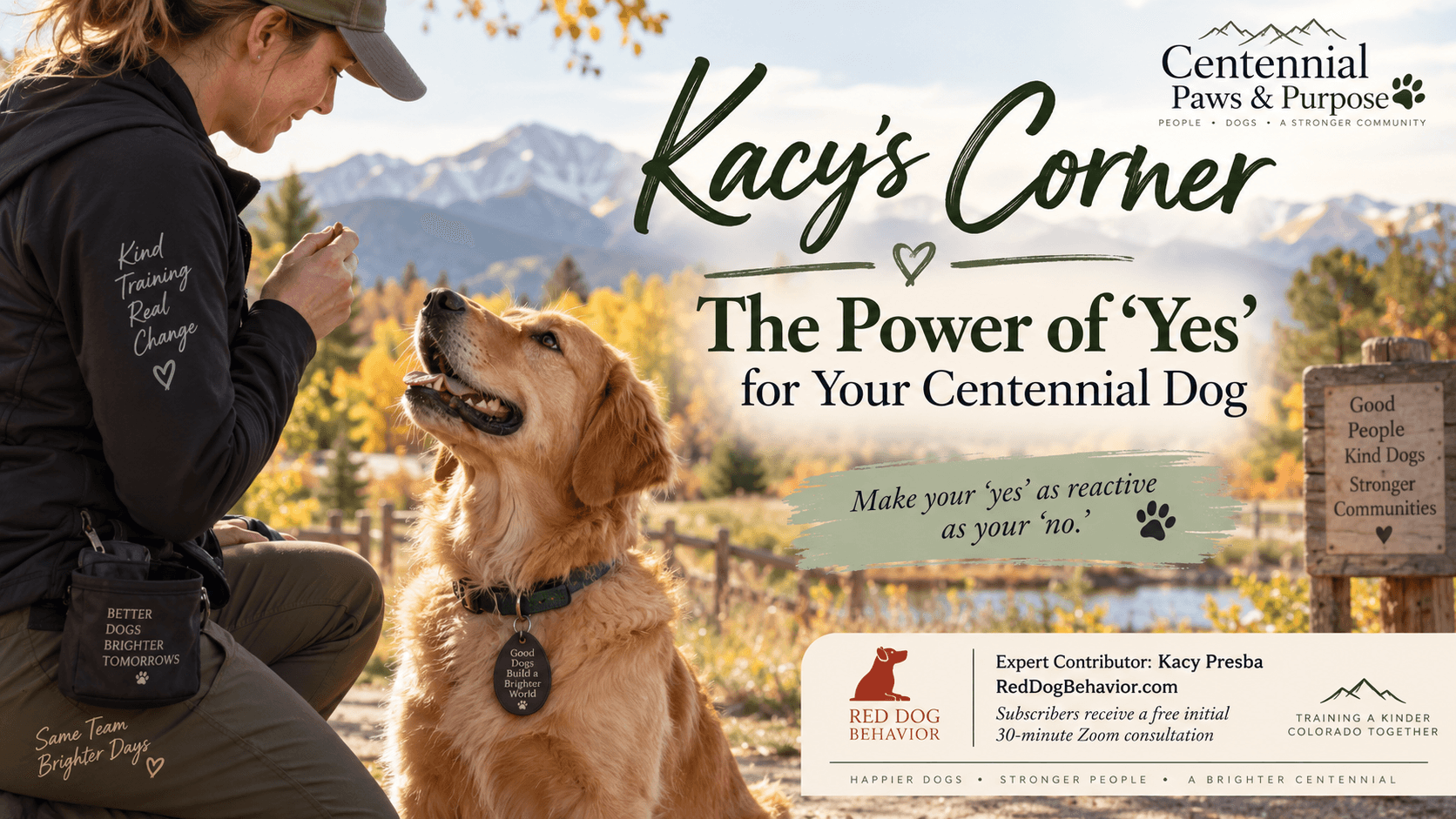
Expert Contributor: Kacy Presba, Red Dog Behavior
Last week, we talked about learning to notice what our dogs are telling us through body language.
This week, we turn the conversation around.
How clearly are we talking back?
One of the simplest and most effective tools in force-free training is a marker word, often something as easy as:
“Yes.”
That one little word can become a bridge between your dog’s behavior and the reward that follows.
Used well, it tells your dog:
“That. Right there. That is the choice I wanted.”
Why Timing Matters
Dogs live in the moment.
If your dog sits, then stands, then looks at you, then receives a treat five seconds later, which behavior earned the reward?
From the dog’s perspective, the answer may not be obvious.
A marker helps solve that problem.
Imagine taking a photograph of the exact behavior you want to reinforce.
Your dog looks back at you instead of pulling toward another dog.
Yes.
Your dog keeps four paws on the floor as someone enters.
Yes.
Your dog voluntarily settles on their bed while you prepare dinner.
Yes.
The marker happens immediately.
The reward can follow a moment later.
That timing helps your dog connect the dots.
“Yes” Should Predict Something Good
At first, your marker word needs meaning.
You can teach it very simply.
Say “Yes,” then give your dog a small treat.
Pause.
Say “Yes,” then give another treat.
Repeat several times.
You are not asking your dog to do anything yet. You are simply teaching:
When you hear this word, something good follows.
Soon, “Yes” becomes useful information.
And that is when training gets much more interesting.
Make Your Yes as Reactive as Your No
This idea remains at the heart of our Kacy’s Corner series.
We humans are remarkably quick when something goes wrong.
A dog jumps.
“No!”
A dog grabs a sock.
“No!”
A dog barks.
“No!”
Our reaction can be nearly instantaneous.
But when the dog lies quietly beside us for twenty minutes?Silence.
When they pass the trash can without investigating?
Nothing.
When they look at us instead of barking?
We may not even notice.
So here is this week’s challenge:
Make your “yes” as reactive as your “no.”
Start hunting for the behavior you want.
Do not wait for perfection.
Mark the tiny pieces.
One loose-leash step.
One calm glance.
One good decision.
One moment of patience.
Those little moments are the building blocks of bigger behaviors.
A Marker Is Not the Same as Praise
You can absolutely praise your dog, and you should.
But a marker has a more specific job.
“Good dog!” may mean many things.
“Yes” should mean one thing:
The behavior happening at that exact moment earned reinforcement.
Think of the marker as punctuation.
It puts a period at the end of the correct answer.
Praise can come afterward, along with the treat, toy, sniff break, play session or whatever your dog finds rewarding.
Food Is Not Bribery
Treats sometimes get an unfair reputation.
Using food in training does not mean your dog will only behave when you are holding a snack.
Food is simply one form of reinforcement, and for many dogs, it is a very effective one.
We use rewards all the time in human life.
Paychecks.
Grades.
Thank-you notes.
Applause.
A good cup of coffee after finishing something difficult.
Dogs are not so different.
Once a behavior becomes reliable, rewards can become more varied and less predictable.
The goal is not to carry a fistful of chicken forever.
The goal is to create a strong history of:
“When I make this choice, good things happen.”
This Week’s Five-Minute Practice
Pick one behavior your dog already offers naturally.
Maybe they:
For five minutes, catch that behavior.
The instant it happens:
Yes. Reward.
Then watch.
You may be surprised how quickly your dog begins offering the behavior again.
That is not magic.
That is communication.
And once we become better at marking the choices we love, training becomes less about constantly telling our dogs what not to do.
We begin showing them, clearly and consistently, what does work.
Ask Kacy
Kacy Presba | Red Dog Behavior
Kacy provides force-free, relationship-based training for family dogs and owner-trained service-dog teams, including basic obedience, behavior modification, fear and reactivity support, Canine Good Citizen evaluations and public-access preparation.
🐾 Complimentary Subscriber Consultation
Centennial Pulse and Paws & Purpose subscribers receive a FREE initial 30-minute Zoom consultation with Kacy.
Simply mention Centennial Pulse or Paws & Purpose when reaching out.
Website: RedDogBehavior.com
Call/Text: 303-356-9330
Email: kpresba@gmail.com
32 Comments
Join the conversation
Just started with a rescue, so this series is perfect timing. The clear steps are really helpful for us newbies.
This sounds good and all but my husky is stubborn. Not sure that a marker word alone will get through to her.
Huskies can be independent-minded for sure, but with consistent timing and rewards that really motivate her, a marker word helps clarify what you're asking.
Have to admit, I get impatient waiting for perfect behavior. Focusing on small steps will maybe keep me more positive.
Thank you for sharing that! Catching and marking small, positive choices can absolutely help shift your mindset and your dog's learning experience.
It really is easy to forget to reward the good stuff. My golden just lay next to me while I worked and I barely noticed. Not anymore!
Nina34My lab does this too! Once I started noticing and rewarding those quiet moments, she started offering them way more often. Makes a big difference.
My dog loves toys more than food. Can you use a tug or ball as the reward with the 'yes' marker?
Absolutely! You can pair 'yes' with any reward your dog values, such as a favorite toy or game, it's all about what motivates your pup.
I've used clickers before but saying 'yes' does feel quicker and less awkward in public. Going to switch it up.
Lupe D.I switched from a clicker to just saying 'yes' too. My dog didn't seem to mind and it was a lot easier at the park when my hands were full.
I always thought using food meant my beagle would only listen if I had treats. Glad to know that's not true!
I appreciated the part about little moments being building blocks. Sometimes I forget those tiny successes matter.
Jeanette W.Same! I tend to focus on the big improvements, but honestly, the small wins add up fast. Thanks for the reminder.
Thank you for noticing that point, those tiny moments are like bricks in the foundation of more reliable, long-term behavior.
This sounds good but will it work with older dogs too? Ours is 8 and kind of set in his ways.
Great question! Positive reinforcement and marker training can be effective for dogs of any age, older dogs can learn new things, too.
Love that you mention this isn't magic. Makes me feel better about my progress with our rescue pup. It's all about clear communication.
This is helpful but I don’t always carry treats around. Do you just use praise after a while or switch rewards?
Sandy RiosYou can definitely mix it up! Sometimes I use praise, or a quick game, or even let my dog sniff around as a reward if I don't have treats on me.
Honestly, sometimes my dog just ignores me, even with treats. Maybe I need to work on the timing instead of blaming him.
You’re exactly right, timing often matters more than the treat itself, so focusing on when you mark the behavior can unlock more success.
I always wondered how trainers made dogs so responsive. Didn't realize the marker word was so important! Thanks for breaking it down.
Five minute practice with 'yes' was surprisingly effective! My terrier kept sitting near the door all evening hoping for treats lol.
That’s wonderful to hear, terriers do love to work for rewards! Catching those offered behaviors can spark more of what you want to see.
It's true, I'm so fast to scold but rarely notice quiet good moments. Going to look for those calm glances more.
I actually started using 'good' as my marker word, but maybe I should switch to 'yes' like you suggest. Anyone else tried both?
Renae P.I've used both. 'Good' worked okay, but 'yes' did seem to click faster for my pup, maybe because it's short? Still, use what feels natural to you.
The photograph example is super helpful. I never thought about timing quite like that before. Need to work on being quicker with my marker word.
So glad the photograph analogy resonated! Practicing the speed of your marker word really does make a big difference in your dog's understanding.
This makes a lot of sense, especially about the treats not being bribes. My lab is so food motivated, I felt bad about it but now I see it differently.
I've always been guilty of only saying no when my dog does something wrong. Going to try using yes more and see if it helps!