Expert Contributor: Kacy Presba, Red Dog Behavior
There is something especially inviting about taking a dog for a walk when the Colorado air turns crisp. The leash comes out, the tail starts moving, the front door opens and suddenly your quiet companion appears to have somewhere extremely important to be.
Preferably six feet ahead of you.
For many dog owners, pulling becomes one of the most frustrating parts of walking. We tighten the leash, the dog pulls harder, we stop, start again and sometimes spend the entire walk feeling as though both ends of the leash are negotiating different travel plans.
But here is an important place to begin: pulling does not mean your dog is stubborn, dominant or trying to be difficult.
Dogs naturally move faster than we do, and the outside world is bursting with information. There are smells, sounds, other dogs, wildlife, people and countless fascinating things we cannot even detect. Walking slowly beside a human on a six-foot leash is actually a skill we have to teach.
And like the other skills we have explored in Kacy’s Corner, force-free leash walking begins by noticing and reinforcing what we want.
Start Before You Leave the House
If your dog becomes wildly excited the moment the leash appears, training can begin before you ever reach the sidewalk.
You do not need to punish that excitement. Instead, slow the process down enough for your dog to succeed. Pick up the leash. If your dog offers a moment of calm, mark it with your familiar “Yes” and reinforce it. Clip the leash on when four paws are on the floor. Pause at the door. Reward a check-in.
Those tiny moments matter.
We are teaching that getting outside does not require launching through the doorway like a furry cannonball.
This does not mean your dog must sit perfectly still before every walk. The goal is simply to create a little communication before the excitement begins.
Reward the Place You Want Your Dog to Be
Once outside, many people make the mistake of noticing the leash only when it becomes tight.
There is that squeaky-wheel problem again.
Your dog pulls.
We react.
But what about the three steps before the pull, when the leash was loose?
That is where the training opportunity lives.
When your dog is walking near you and the leash is relaxed, mark it.
Yes.
Reward near the position where you would like your dog to continue walking.
Then keep moving.
You do not need military precision. Your dog does not have to glue their shoulder to your knee for an entire neighborhood walk. For most family dogs, the practical goal is much simpler: a loose leash, awareness of the person holding it and the ability to move together comfortably.
Sniffing Is Not the Enemy
Sometimes we become so focused on getting somewhere that we forget what a walk means to a dog.
To us, the goal may be exercise.
To your dog, the neighborhood is today's newspaper.
Who passed this tree? Was there a rabbit here? Is that the dog from three houses down? What happened near this bush? Has someone committed the outrageous act of dropping a potato chip nearby?
Sniffing is an important part of how dogs explore their environment.
Rather than viewing every sniff as a distraction, use access to sniffing as part of the reinforcement.
Your dog gives you several nice loose-leash steps and checks in?
Yes. Go sniff.
Now something your dog already loves becomes part of the training.
Force-free training becomes especially effective when rewards are not limited to treats. Food can be wonderful, but so can sniffing, movement, play and access to the environment.
When the Leash Gets Tight
If your dog reaches the end of the leash, resist the urge to jerk them backward.
Instead, think about what you want to teach.
You might stop moving and wait for the leash to soften. You might change direction and encourage your dog to follow. You may need to increase your distance from something that is simply too exciting.
The important part is avoiding a battle of force against force.
A dog pulling toward another dog from ten feet away may not be ready to practice beautiful loose-leash walking at that distance. Cross the street. Create more space. Find the point where your dog can notice the distraction and still think.
Remember what we learned about check-ins?
Your dog sees the distraction, then turns toward you.
Yes.
There it is again.
These skills begin stacking on top of one another.
Equipment Should Support the Dog, Not Punish Them
Comfortable, properly fitted equipment matters. A well-fitted harness or collar and an appropriate leash should allow you to handle your dog safely without relying on pain, intimidation or physical corrections.
Tools designed to hurt, startle or tighten painfully around the dog are not necessary for teaching loose-leash skills.
Red Dog Behavior’s approach is rooted in force-free, relationship-based training built on trust, wellness, respect and mutual understanding. Kacy also works from basic obedience through owner-trained service-dog preparation, where calm, reliable movement with the handler becomes increasingly important.
The Walk Does Not Have to Be Perfect
Some walks will feel wonderful.
Some walks will include squirrels.
Those are not always the same walk.
Do not measure success by whether your dog walked perfectly beside you for thirty minutes. Look for the small improvements.
Five loose-leash steps instead of two.
A check-in before pulling.
Walking past one driveway calmly.
Choosing you over a smell for just a second.
Recovering more quickly after something exciting passes.
Catch those moments.
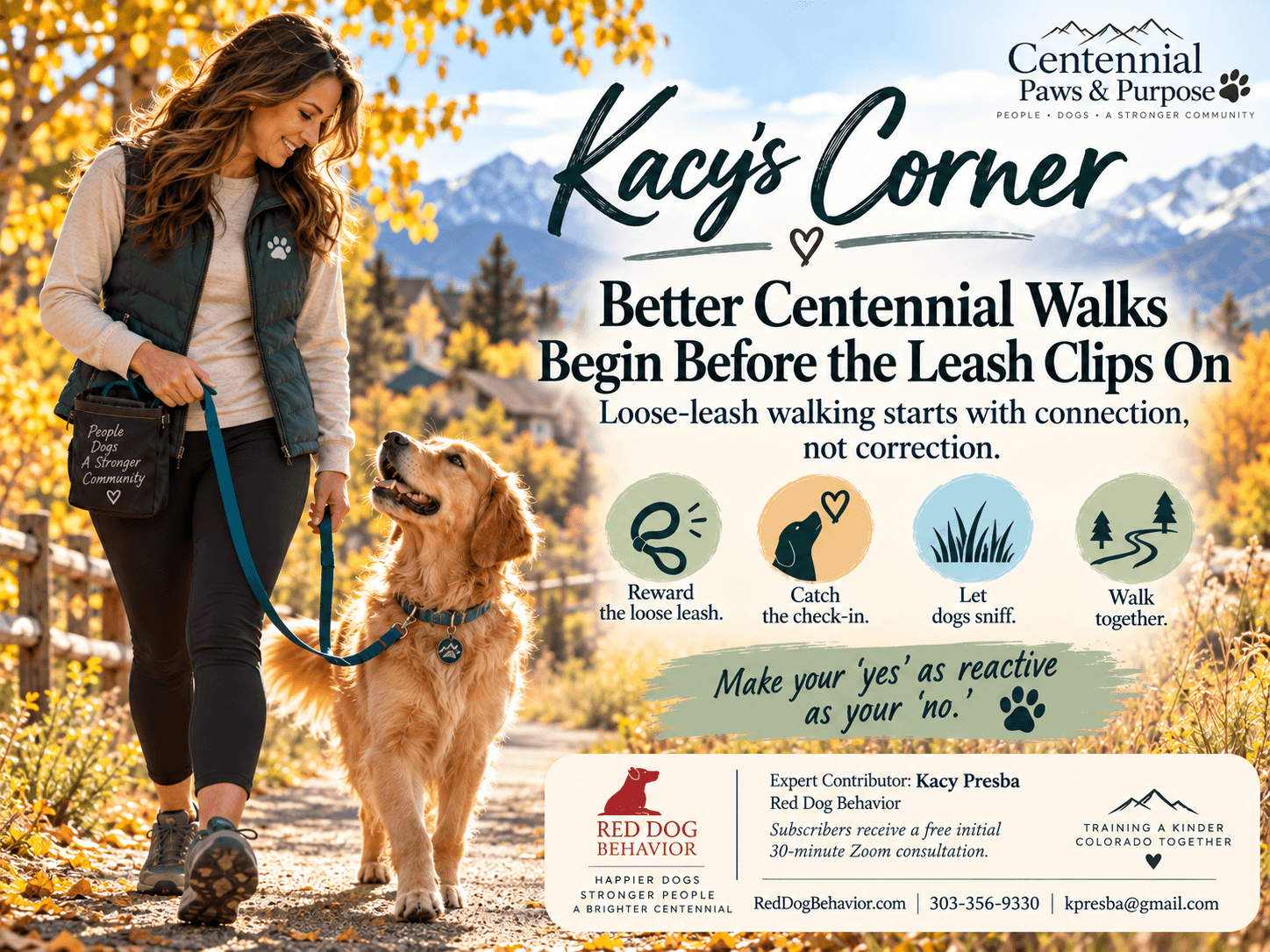
Make your “yes” as reactive as your “no.”
When we become better at noticing the behavior we want, the walk stops being an endless series of corrections and begins becoming a conversation between two partners moving through the world together.
This Week’s Five-Minute Challenge
On your next walk, forget about fixing the entire walk.
Choose five minutes.
During those five minutes, become a detective for one thing only: a loose leash.
Every time the leash forms that relaxed little curve between you and your dog, notice it. Mark it. Reinforce it.
If your dog checks in, celebrate that too.
Then give them time to sniff, explore and be a dog.
Loose-leash walking is not about removing everything your dog loves about going outside.
It is about helping your dog discover that the best walks happen when the two of you travel together.
Ask Kacy
Kacy Presba | Red Dog Behavior
Kacy has well over 20 years of experience and provides force-free, relationship-based training ranging from foundational obedience and behavior modification to owner-trained service-dog preparation, Canine Good Citizen evaluations and Public Access Test readiness.
Complimentary Subscriber Consultation
All Centennial Pulse and Paws & Purpose subscribers receive a FREE initial 30-minute Zoom consultation with Kacy.
Mention Centennial Pulse or Paws & Purpose when reaching out.
Website: RedDogBehavior.com
Call/Text: 303-356-9330
Email: kpresba@gmail.com

28 Comments
Join the conversation
Glad to see more trainers talking about relationship-building and not just obedience drills.
I really liked 'make your yes as reactive as your no.' Love that simple advice. Going to try being more positive.
Anyone have tips for walking two big dogs at once without getting pulled over? These ideas help with one, not sure about a duo.
Great question! Walking two strong dogs can definitely be a challenge, try practicing loose-leash skills with each individually, then together in short bursts, and consider equipment like a double-leash coupler for safety and control.
We moved here last winter and walks are extra exciting for our dog. Force-free training helped us settle in!
We love hearing that, new environments are full of excitement, and a force-free approach really does help dogs feel secure while exploring their new world.
I look forward to walking more now that it's not just about exercise. The newspaper analogy made me laugh.
My dog always gets super hyped when the leash comes out. Going to reward the quiet moments like you suggested.
I appreciate the point about equipment. So many people yank on choke chains when a basic harness would work better.
Just tried this and letting my pup sniff really does make walks calmer. He doesn't pull as much when he gets his sniffs!
The 'check-in' cue was a game-changer for us. Now Sadie looks up at me every time a skateboard goes by. Progress!
That’s fantastic to hear, check-ins really are a powerful way to build communication, especially during those high-distraction moments!
Can you do force-free methods with dogs who get SO distracted by squirrels? My terrier seriously loses her mind.
Yes, force-free methods can absolutely help even the most squirrel-crazy pups, start practicing at a distance where your terrier can still focus, and celebrate any check-ins or glances back your way.
Changing direction when the leash gets tight has really worked for my lab. He just wants to follow wherever I head!
Wonderful to hear, changing direction is a simple, effective tool, and it really encourages your dog to keep an eye on you as the leader of your little adventure!
Small improvements are so easy to overlook. Needed that reminder. We had our first peaceful 3 minutes today!
Congratulations on your three peaceful minutes, that’s exactly the kind of progress to celebrate, and it adds up over time.
Not sure stopping every two steps for treats is realistic but I get the message about reinforcing the good stuff. Food for thought.
Absolutely, frequent rewarding isn’t meant to be a lifelong strategy, once your dog starts to get the idea, you can reduce the treats and use things like sniffing and praise as powerful rewards, too.
Wish I'd read this before giving up on teaching Daisy leash manners! Might start again now with these tips.
The five-minute challenge idea was smart. Breaking it up like that sounds more doable than a perfect walk.
I used to try prong collars but felt bad about it. Glad to see force-free is better for building trust. Harness it is from now on.
Thanks for saying it's not about dominance. My neighbor always says my dog is just stubborn, but maybe he just needs to learn.
Love the part about sniffing being important. Our golden stops at every bush and I used to get annoyed. Now it makes sense!
Samantha P.Same here! My lab is obsessed with sniffing everything. Letting him take his time has made our walks so much easier too.
I thought I was the only one whose dog acts like a rocket at the start of a walk. Will try the calm before the door thing and see if it helps.
You’re definitely not alone! Slowing things down before you leave can make a big difference, let us know how it goes.