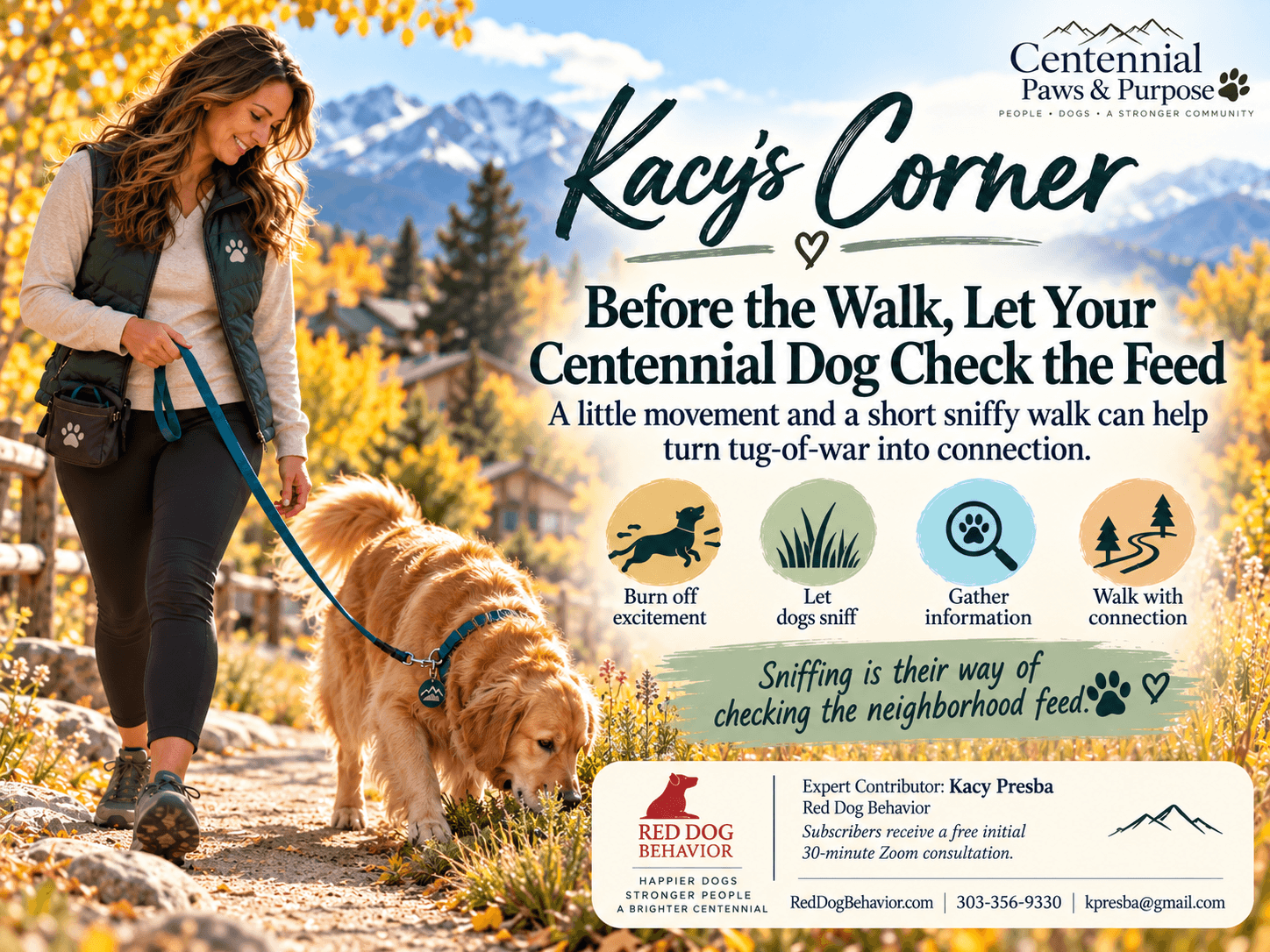
Expert Contributor: Kacy Presba, Red Dog Behavior
Last week, we talked about loose-leash walking and the importance of rewarding the moments when your dog is already getting it right.
But there is another piece of the puzzle that deserves its own conversation.
Sometimes a walk feels terrible before the dog has even had a fair chance to settle into it.
The leash clips on. The front door opens. Your dog launches forward, nose down, body buzzing, trying to reach every tree, bush, patch of grass and suspiciously interesting mailbox at once.
It is easy to label that behavior as pulling, disobedience or poor manners.
But Kacy Presba of Red Dog Behavior points to two major factors that often sit underneath that kind of walk:
Excitement and information gathering.
Understanding both can change how we prepare for the walk before we start correcting anything on it.
Sometimes They Need to Get the Ants Out of Their Pants
For some dogs, the leash itself predicts one of the best parts of the day.
The excitement begins before the door even opens.
Expecting a dog who has been waiting all morning to instantly stroll calmly down the sidewalk can be a little like asking a child to walk quietly into an amusement park.
Sometimes the body needs somewhere for that energy to go first.
Before starting the actual neighborhood walk, try a few minutes of movement or simple training. That might mean a short game of fetch, several easy repetitions of sit and down, a little tug, or another familiar activity your dog enjoys.
The goal is not to exhaust your dog.
It is simply to take the edge off the initial burst of excitement so they are more able to think, connect and move with you once the walk begins.
And Sometimes They Need to Check Their Feed
Then there is sniffing.
Humans often experience sniffing as an interruption to the walk.
The dog stops.
Again.
At another tree.
For what appears to us to be no reason whatsoever.
But there is a reason.
Your dog is gathering information.
Think about the way we check Facebook, scroll through neighborhood updates or open Waze before heading somewhere. Sometimes there is something interesting. Sometimes there is nothing worth stopping for, so we keep scrolling.
Your dog's nose is doing something remarkably similar.
That patch of grass might reveal that another dog passed recently. A tree can carry information about who has been in the neighborhood. Scents can tell a dog about animals, people, changes in the environment and what may be waiting farther along the route.
They are not trying to make the walk difficult.
They are checking their world.
In dog terms, sniffing is the neighborhood feed.
Try a Sniffy Walk Before the Walk
One way to work with that need instead of fighting it is to intentionally give your dog a short sniffy walk before asking for more structured loose-leash walking.
For a few minutes, let the purpose of the outing be information gathering.
Encourage your dog to sniff. Move slowly. Pay attention to what catches their interest. Let them explore a small area without rushing them from one smell to the next.
Stay engaged while they do it.
This is not simply standing at the end of the leash while your dog disappears into the bushes mentally. Watch them. Notice where they pause.
Notice what they investigate and what they choose to ignore.
There is a wonderful side benefit here.
You begin seeing a little more of the world your dog sees.
A spot you would have walked past without noticing may be absolutely fascinating to them. Another area may cause them to slow down, become more alert or look back at you.
That information is useful to you, too.
Sniffing Can Help the Walk Become Easier
If your dog has already had a chance to gather some of the information they are desperately seeking, they may have less urgency to drag you toward every smell once the actual walk begins.
Similarly, if they have already moved their body and released some of that initial excitement, they may be better able to offer check-ins, walk on a loose leash and respond to the skills you have been practicing.
We are not rewarding pulling.
We are addressing some of the reasons the pulling happens in the first place.
That distinction matters.
Force-free training is not just about replacing punishment with treats. It also asks us to understand the need underneath the behavior and set the dog up to succeed.
Sometimes the best loose-leash training happens before the loose-leash portion of the walk ever starts.
Think Waze, Not Willfulness
Imagine preparing to drive across town.
Most of us would not consider checking Waze to be stubborn behavior.
We want information.
Is there traffic?
Is the usual route clear?
Did something happen ahead?
Do we need to adjust?
Dogs are often looking for their version of the same answers.
Their tools just happen to be attached to the front of their face.
When your dog stops to sniff, they may be figuring out who came through, what changed and whether anything ahead deserves attention.
That does not mean every walk must take two hours or every smell must be investigated indefinitely. Boundaries and structure still matter.
But when we understand what the dog is trying to accomplish, we can make smarter choices about when to let them investigate, when to encourage movement and when to ask for connection.
Not Every Pull Has the Same Cause
Excitement and information gathering are two of the biggest contributors Kacy sees in dogs who are walked regularly, but they are not the only reasons dogs pull.
A dog may pull toward a friend.
Toward another dog.
Toward wildlife.
Toward food.
Toward an object they want to investigate.
Fear can also change how a dog moves on leash.
That is why there is no single leash trick that fixes every dog.
Behavior has context.
The better question is not simply, “How do I stop the pulling?”
It is:
“Why is my dog pulling right now?”
That question gives us somewhere useful to begin.
This Week’s Challenge
Before one of your regular walks, experiment with changing the first five minutes.
If your dog begins the outing bursting with energy, spend a few minutes on movement, play or easy training first.
Then offer a short sniff-focused outing where exploration is the point.
Watch what your dog notices.
Let them check their feed.
Then begin your regular walk and see whether anything feels different.
You may find that when the excitement has somewhere to go and the information has already been gathered, there is a little less urgency at the end of the leash.
Less tug-of-war.
More connection.
And maybe even a chance for both of you to enjoy the walk you were trying to take in the first place.
Ask Kacy
Kacy Presba | Red Dog Behavior
Kacy provides force-free, relationship-based training for family dogs and owner-trained service-dog teams, including foundational obedience, behavior support, fear and reactivity work, Canine Good Citizen evaluations and public-access preparation.
Complimentary Subscriber Consultation
All Centennial Pulse and Paws & Purpose subscribers receive a FREE initial 30-minute Zoom consultation with Kacy.
Mention Centennial Pulse or Paws & Purpose when reaching out.
Website: RedDogBehavior.com
Call/Text: 303-356-9330
Email: kpresba@gmail.com

28 Comments
Join the conversation
I appreciate that boundaries are still important. I don’t want walks to last forever but letting my pup do a little recon first makes total sense.
Kind of nice to get a dog’s perspective for once. Wish I could know exactly what they’re smelling!
We're glad you enjoyed getting a peek into how dogs experience the world, it really is amazing how much information they gather through their incredible noses!
Good tip about paying attention TO the sniff, not just zoning out. I’m guilty of just staring at my phone while she sniffs. Maybe I’ll join in mentally next time.
I usually lose patience when she stops over and over, but I guess I can spare a couple minutes at the start. Worth a try if it makes walks less stressful.
Darren K.I felt the same way at first, but it’s actually made a difference for my lab. We both end up calmer. Hope it works out for you too!
Thank you for giving it a try! Even a few intentional minutes at the start can go a long way toward a calmer, more enjoyable walk for both of you.
I’ve tried everything with my husky but never a sniff walk first. Will report back! Hoping this calms the wild start we always get.
Wish my HOA would understand that long sniffs are normal and not bad manners. Some neighbors get annoyed if we slow down.
Love the reminder that every dog pulls for different reasons. My rescue is super fearful on certain streets and walks totally different than at the park.
Has anyone tried the play first trick with a really high energy puppy? Just worried mine will get even crazier.
Great question! A short burst of play can help some high-energy puppies actually settle more on walks, but keep sessions brief and low-key if you’re worried about overstimulating your pup.
I've started letting our corgi sniff longer and he actually pulls way less. I thought I was just being lazy but I guess I was doing it right all along!
Every trainer says something different. I tried the no-pull harness and it still didn’t totally fix things. Wonder if the sniffy walk will help.
You’re not alone, no single tool fixes everything because pulling can have many causes, so experimenting with a sniffy walk may help address what the harness couldn’t.
The Waze comparison was perfect! Never heard it put that way but it’s true, I’m always checking my phone too. Makes sense dogs want to know what’s up.
Thank you! We love the Waze comparison too, it’s a great reminder that dogs, like us, are just trying to understand and navigate their environment.
My terrier always wants to see what’s ahead no matter what. I guess I get it now, but sometimes we just don’t have 30 minutes for every tree!
Honestly, sometimes the walk does feel like a tug-of-war. Good to hear there are practical ways to avoid it besides just yanking back.
This explains why my golden gets so wild before walks. She nearly knocks me over at the door. Gonna try some sit/down reps before we leave.
I never thought to actually watch what my dog was smelling, just tugged her along. I’ll try paying more attention next time. Maybe I’ll learn something new too.
You might be surprised by what you notice, watching your dog's sniffing interests can reveal a whole new world and deepen the connection between you both.
I wish more trainers talked about this. I've always wondered why some dogs just pull so hard even after years of practice. Makes me rethink my approach.
We appreciate your thoughtful reflection, understanding the reasons behind pulling can make a big difference, even for seasoned pups and their people.
I like the idea of a sniffy walk before the walk. My dog is a beagle so sniffing EVERYTHING is his whole world. Makes sense to give him some time for it on purpose.
It's nice to hear an explanation for all that sniffing. I used to get so annoyed waiting at every mailbox. I’ll try to be more patient now.
The part about excitement makes sense. My lab always acts like he hasn't been out in years even if it's only been a day. Going to try a quick game in the yard before we walk and see if it helps.
That’s a fantastic plan! A quick game before heading out can help manage some of that initial excitement and set the tone for a more peaceful walk.