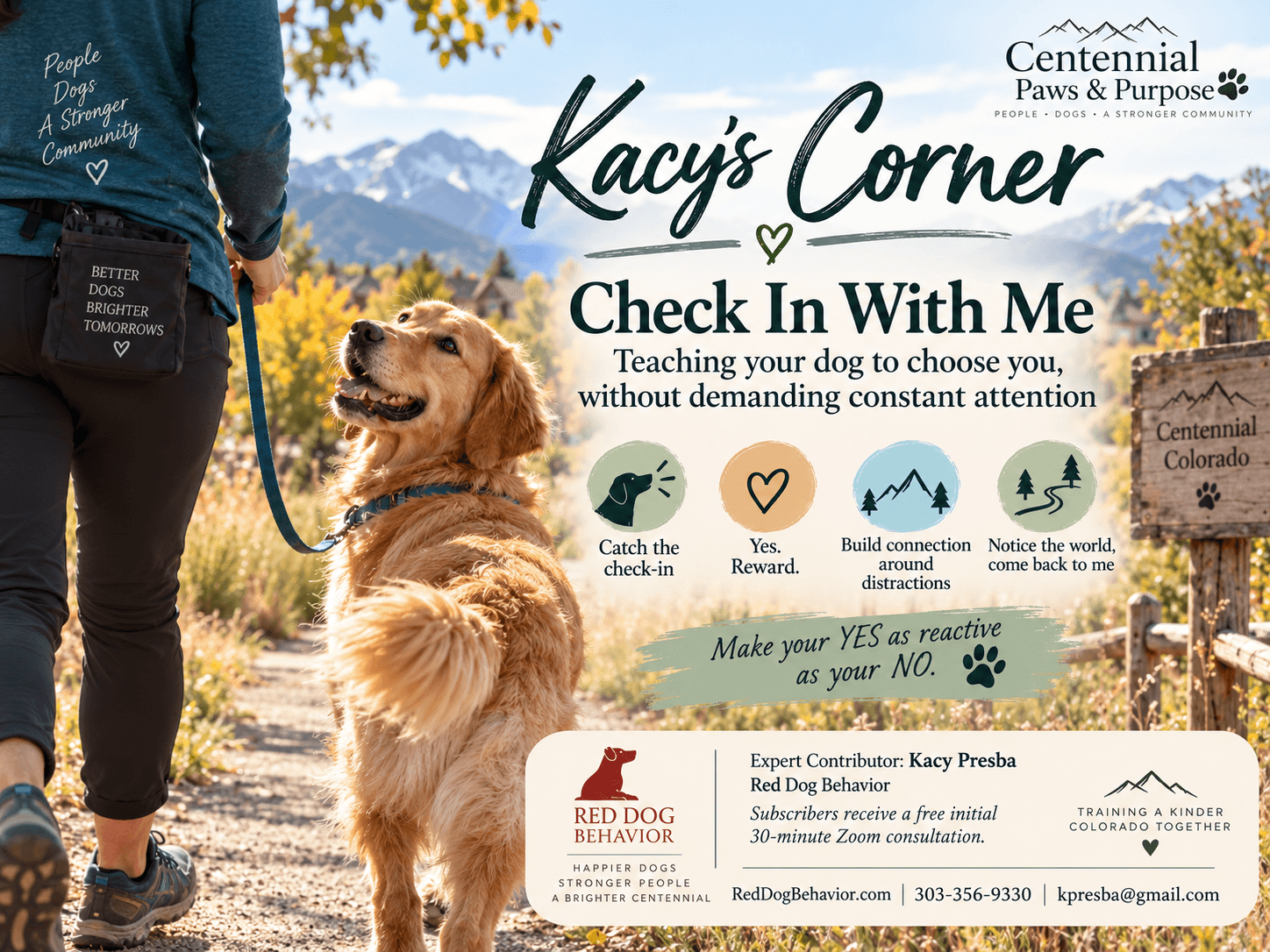
Expert Contributor: Kacy Presba, Red Dog Behavior
You are walking through the neighborhood when your dog spots something interesting across the street. Maybe it is another dog, a rabbit, a bicycle or a person carrying a suspiciously fascinating grocery bag. Your dog notices it, takes it in and then, for just a moment, turns their head and looks back at you.
That tiny glance may not seem like much, but in force-free training, it can be gold.
Yes. Reward.
Your dog just made a choice to check in with you, and that is a behavior worth growing.
When people think about having a dog’s attention, they sometimes picture a dog staring continuously at their handler, waiting for the next instruction. Real life does not look like an obedience demonstration, though. Dogs are supposed to notice their environment. They smell things we cannot smell, hear things we cannot hear and are constantly gathering information about the world around them.
Our goal is not to teach a dog to ignore everything except us. Instead, we can teach something much more practical: you can notice the world, and you can come back to me.
That voluntary reconnection is often called a check-in. For a family dog, check-ins can make walks calmer and communication easier. For a service or mobility dog, the ability to notice environmental information and then reconnect with the handler can become an important foundation for more advanced work.
Start Catching the Check-In
You do not necessarily have to ask for this behavior. In fact, one of the easiest ways to begin is simply to catch your dog doing it.
Start somewhere relatively boring, perhaps inside your home or in the backyard. Let your dog look around. The moment they voluntarily turn toward you, say “Yes” and reward them.
For this exercise, resist the urge to immediately ask for a sit, down or another behavior. The check-in itself is what you are reinforcing.
Let your dog look away again, then wait. When they choose to reconnect, mark it and reward again.
Over time, you are teaching something very simple and very useful: checking in with my person is worthwhile.
Once your dog begins offering check-ins in a quiet environment, start taking the exercise on the road. Choose an area that is interesting without being overwhelming. Your dog sniffs a bush, then glances at you. Yes. Your dog watches someone walk past, then turns toward you. Yes. Your dog hears a sound, pauses and checks in. Yes.
And remember, the reward does not always have to be food.
Sometimes the reward can be, “Yes, go sniff!” For many dogs, permission to investigate an interesting patch of grass is far more exciting than a treat.
Force-free training becomes especially powerful when we learn what our individual dog actually values.
When the Distraction Is Too Much
What happens if your dog cannot look away from the distraction at all?
That tells you something, too.
If your dog is staring intensely, pulling, barking or suddenly unable to respond in an environment where they normally can, the answer is usually not to become louder. Repeating, “Look at me. Look at me. LOOK AT ME!” does not necessarily make the task easier.
Your dog may simply be too close to something exciting, frightening or overwhelming.
Create more distance. Cross the street. Step farther away. Move behind a visual barrier. Give your dog enough space that thinking becomes possible again. Then watch for even the smallest moment of disengagement, perhaps a head turn, an ear turning toward you or a quick glance.
Yes.
We do not need to wait for perfection before acknowledging progress.
Eye Contact Is Not the Only Kind of Connection
Humans place enormous value on eye contact, but dogs do not experience communication exactly as we do. Some dogs enjoy looking directly at their people, while others may find prolonged eye contact uncomfortable, particularly dogs who are fearful, anxious or still building trust.
A check-in does not have to mean staring into your eyes. Your dog may turn their head toward you, move closer, orient their body toward you or briefly glance in your direction.
This is where everything we have been learning about canine body language comes back into play. Look at the whole dog.
Communication is bigger than one behavior.
There is another side to this exercise as well. If every time your dog looks at you the result is, “No,” “Leave it,” “Stop,” “Come inside” or “Walk faster,” checking in may not become especially appealing.
Sometimes looking at you should predict good things. A treat. Praise. A sniff. A game. Moving toward something interesting. Simply continuing the walk together.
That brings us back to the idea at the center of this Kacy’s Corner series:
Make your “yes” as reactive as your “no.”
We are often incredibly quick to notice when our dogs disconnect from us. This week, become equally quick at noticing when they reconnect.
This Week’s Five-Minute Challenge
Take five minutes with your dog and resist the urge to repeatedly call their name. Instead, simply observe.
Every time your dog voluntarily checks in with you, mark it with your “Yes” and reinforce it. Start somewhere easy, then gradually practice in slightly more interesting environments.
You are not demanding attention. You are making connection valuable.
And over time, something wonderful begins to happen. In a world filled with smells, sounds, squirrels, neighbors, dogs and distractions, your dog begins making a choice:
“I should check in with my person.”
That is more than obedience.
That is partnership.
______________________________________________________
Ask Kacy
Kacy Presba | Red Dog Behavior
Kacy provides force-free, relationship-based training for family dogs and owner-trained service-dog teams, including foundational obedience, behavior modification, fear and reactivity support, Canine Good Citizen evaluations and public-access preparation.
Complimentary Subscriber Consultation
All Centennial Pulse and Paws & Purpose subscribers receive a FREE initial 30-minute Zoom consultation with Kacy.
Mention Centennial Pulse or Paws & Purpose when reaching out.
Website: RedDogBehavior.com
Call/Text: 303-356-9330
Email: kpresba@gmail.com
32 Comments
Join the conversation
Read this with my coffee, then spent 5 min watching my dog check in like five times in the yard. Gave a treat every time, she loved it!
That’s wonderful to hear, those little moments of connection make a big difference, and your dog clearly enjoyed the recognition!
This approach feels so much kinder. I don’t want my puppy to be afraid to look around or explore.
I get frustrated when my dog gets fixated, but I never thought just moving further away could reset him. Going to try that.
Does anyone have tips for practicing this in busy parks? My dog checks in nonstop at home but forgets me at the park.
Great question! Try starting at the edge of the park or during quieter times, and reward even the smallest glances or head turns toward you before gradually working up to busier settings.
kelly_dogmomI get the same thing at Clement Park! What helped me is starting at the edge where it’s quieter, then rewarding even the smallest check-in. Sometimes I bring extra tasty treats at first since there’s so much going on.
Appreciate that it’s not just about treats. My dog goes nuts for praise or getting to chase a toy instead.
George LeeSame here! My pup is way more excited for a quick game of tug than treats most days. Sometimes he’ll check in hoping for it, so it keeps things interesting for both of us.
It’s a relief to hear dogs aren’t supposed to ignore the world. Mine is super curious and I worried that was wrong.
Curiosity is completely natural and healthy for dogs, so your dog’s interest in the world is a great sign, not something to worry about.
I liked the idea of making our reactions to check-ins just as strong as our reaction to misbehavior. Feels fairer to the dog.
Thank you for picking up on that point, celebrating positive choices can really help our dogs feel seen and encouraged, just as much as correcting mistakes.
We did something similar in puppy class. It built a lot more trust between us. Thanks for the refresher!
We’re so glad you recognized the value in revisiting this skill. Trust really does grow with these small, consistent check-ins.
Glad someone’s talking about positive training. Too many people just yell at their dogs when they get distracted.
Not so sure this works for all situations. Some distractions are just too much. But I do like the focus on being patient.
That’s a great observation. Sometimes the environment is simply too challenging, and patience combined with creating a little more space can really help.
I always struggle when my dog gets fixated on squirrels. Creating more distance is such a simple solution, but I forget to do it.
You’re not alone, distance is such a simple and effective adjustment, and it’s always okay to take a step back to help your dog succeed.
I tried this with my spaniel in the backyard and was surprised how often she looked at me. Gave her lots of praise and treats, she seemed happy.
Samuel ParkThat’s awesome! I noticed my Aussie started checking in more too once I really paid attention. It’s cool how fast they pick it up if you make it fun.
Really thoughtful advice. It’s almost like training myself as much as training him!
Absolutely, it’s all about building better habits and communication on both ends of the leash!
Works for most dogs but what about the super stubborn ones? My beagle doesn’t care unless food is involved.
Reggie B.Beagles can be tough! I have to rotate treats with my basset, or sometimes let her sniff as a reward. It’s a lot of trial and error to find what’ll get their attention outside.
Honestly never realized how much I said NO compared to YES with my dog. Going to watch for those check-ins from now on.
Love the tip about using sniffing as a reward! My dog would pick sniffing over a treat any day.
We usually try to get our lab to sit every time he looks back at us on walks. I’ll try letting him just check in instead, see how it goes.
Markus D.Letting them just check in has made walks way more chill for us. Our golden got less frustrated when I stopped asking for constant sits. Hope it goes as well for your lab!
I appreciate the reminder that eye contact can be uncomfortable for some pups. My shy rescue hates it when people stare too long.
This makes so much sense. My dog always glances at me during walks but I never thought to reward that. Definitely trying this today!